Description: The purpose of this article is to provide an overview of 2600Hz Emergency Services and how Dispatchable Location Services work on the 2600Hz Platform.
There are two US federal laws enforced by the Federal Communications Commission (FCC) that govern emergency calling requirements for modern telephone and VoIP systems:
- RAY BAUM Act
- Kari’s Law
Together, these laws are intended to improve access to emergency services and ensure that first responders receive accurate location information when a 911 call is made. They apply to many business phone systems, PBXs, and VoIP deployments in the US. This article provides an overview of how the 2600Hz platform supports and works with these services.
Let's explore them individually.
RAY BAUM ACT
Description
The RAY BAUM Act is a US federal telecommunications law (Section 506 of the Repack Airwaves Yielding Better Access for Users of Modern Services Act of 2018). Section 506 requires that emergency calls include a precise dispatchable location so that first responders can quickly locate the caller, especially in MLTS and VoIP environments.
The 2600Hz Platform supports this requirement by allowing administrators to configure both a Base Emergency Address and an Extended Emergency Address. These values can be associated with Emergency Caller ID numbers, users, and devices, allowing emergency responders to receive more accurate location information when a 911 call is placed.
Use Case
When a user places an emergency call, the Emergency Address associated with the caller's number typically provides only a base location, such as a street address. It may not include more specific details, such as a building name, floor, suite, room number, or other dispatchable location information.
In environments such as hotels, campuses, hospitals, warehouses, and office complexes, multiple users or devices may share the same Emergency Caller ID. To help identify the caller's exact location in these scenarios, an Extended Emergency Address can be configured.
When a 911 call is placed, both the Base Address and the Extended Address can be transmitted to the Public Safety Answering Point (PSAP), enabling emergency responders to locate the caller more quickly and accurately.
Configuring the Emergency Base Address
To use this feature, first configure a Base Address for each Emergency Caller ID. If your Emergency Services Provider supports location delivery, this address will be transmitted when a 911 call is placed.
The Base Address can be configured via the Numbers app.
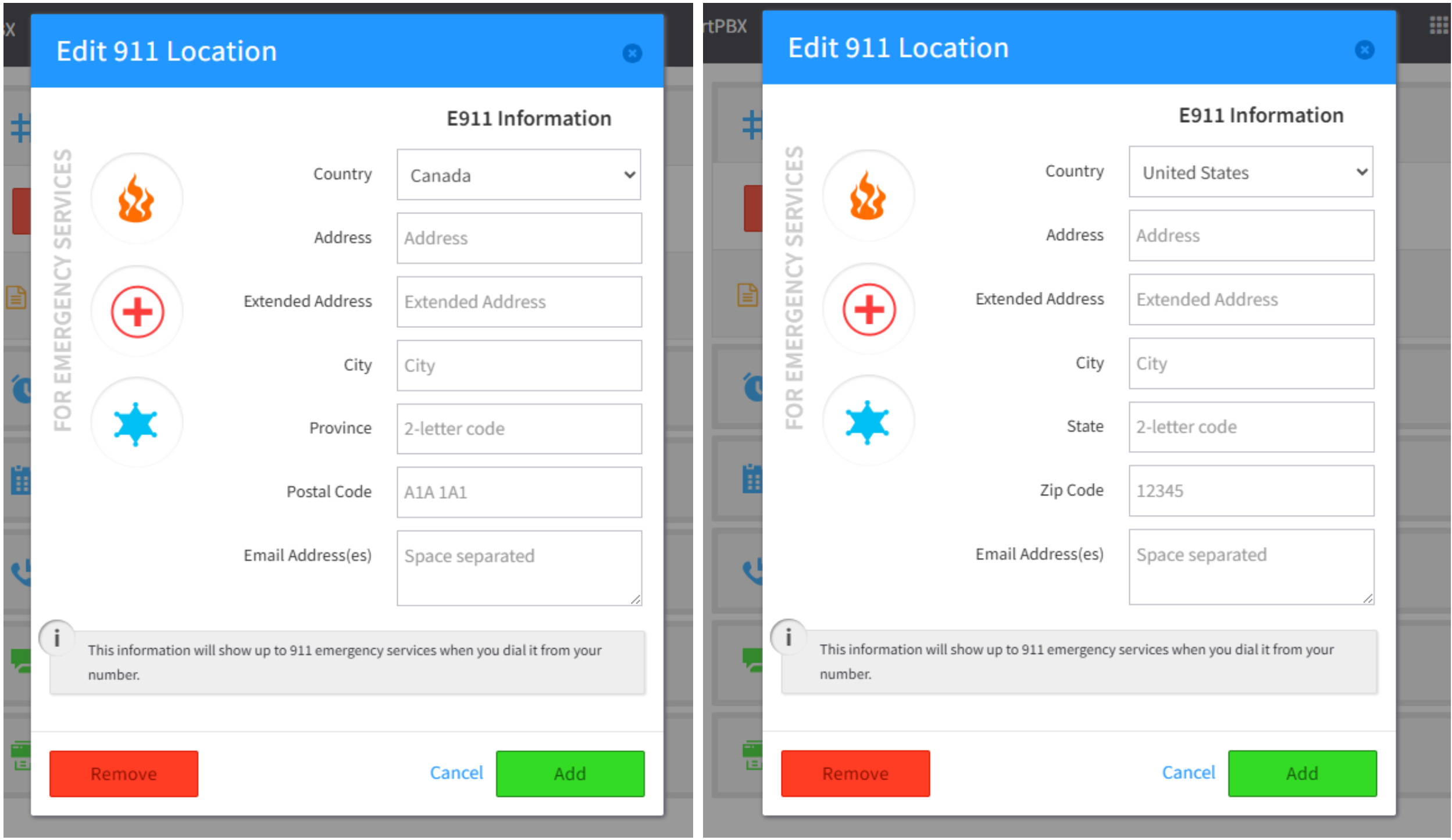
When configuring a phone number, always verify that it has a valid address associated with it.Configuring the Extended Address
Minimum Required Release: 5.4.150Location information can be configured at both the user and device levels. For example:
The Base Address may represent a street address.
An Extended Address configured for a user or device can identify a specific office, workstation, or desk phone location.
Note that device-level Extended Addresses take precedence over user-level Extended Addresses, which in turn override the Extended Address configured in the Numbers app. This hierarchy ensures that emergency responders receive the most accurate location information available for the origin of the emergency call.
Configuring the User-level Extended Address
To configure the user-level Extended Address, go to the CallFlow Editor app. In the app, go to User > Advanced > Caller ID. In this tab, navigate to the “Emergency” section.
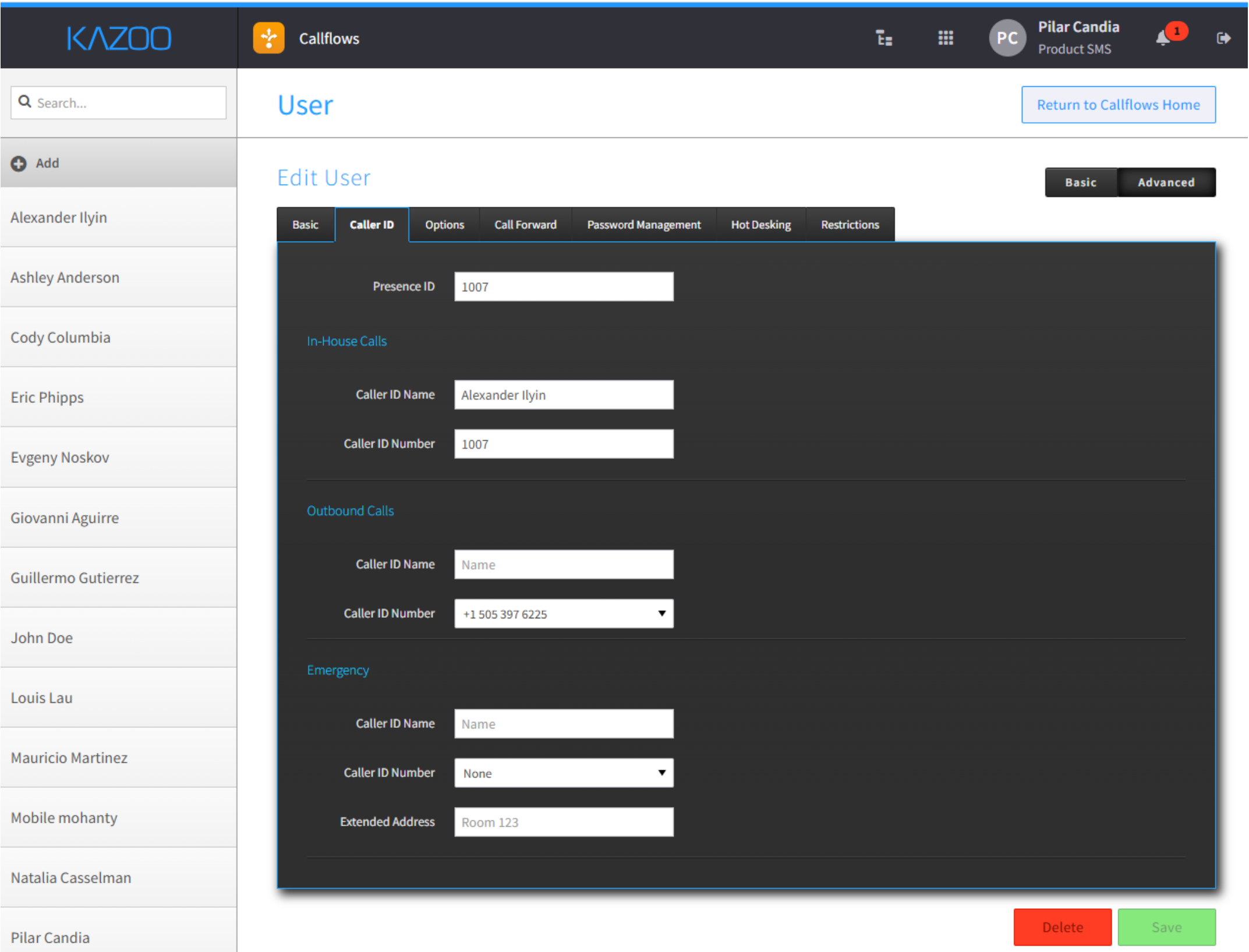
Here, you can configure the Caller ID Name, select the Emergency Services Caller ID Number, and, if needed, add an Extended Address to provide a more precise user location.
The Extended Address field is limited to 20 characters.
Configuring the Device-level Extended Address
To configure more precise information for a specific device, use the CallFlow Editor app. The setup process is very similar to configuring the User-level Extended Address explained above.
In the CallFlow Editor app, select Device > Advanced, then open the Caller ID tab. Configure the Caller ID Name, select the Emergency Services Caller ID Number, and add an Extended Address for a more precise location.
Note that a device-level Extended Address overrides both the user-level and number-level Extended Address.
The Extended Address field is limited to 20 characters.
Dispatchable Location Services
When a 911 call is placed, the Base Address associated with the Emergency Caller ID number, along with the relevant Extended Address, is added to the SIP header of the call and passed to the Emergency Services Provider.
Only one Extended Address is included per emergency call. As a result, when both user-level and device-level values exist, the device-level Extended Address is always selected as the most specific location.
PIDF-LO Requirements
To support dispatchable location delivery described above, the emergency services carrier must support PIDF-LO (Presence Information Data Format–Location Object), an IETF standard used in SIP communications.
If PIDF-LO is not supported, the carrier may use the address stored in its database for the number instead.
Carrier Considerations
The functionality described in this document was tested specifically with Intrado emergency services, used by the 2600Hz Shared Hosted Platform.
Emergency services implementations can vary between carriers. While the 2600Hz Platform provides the dispatchable location information, the manner in which that information is processed, transported, and delivered to emergency responders may differ from carrier to carrier.
It is the responsibility of the carrier providing emergency calling services to support and properly enable PIDF-LO and any related emergency location services required for RAY BAUM Act compliance.
KARI’S LAW
Description
Kari’s Law is a US federal law that requires multi-line telephone systems (MLTS) to allow users to directly dial 911 without needing to dial a prefix (such as “9” to get an outside line). Kari’s Law also mandates that organizations notify on-site personnel when a 911 call is made from their system. It is designed to improve emergency response times and ensure that callers can reach help immediately, regardless of the building or phone system configuration.
Use Case
A hotel guest dials 911 directly from the room phone during an emergency, and the call goes through without having to know a prefix for outbound PSTN dial. At the same time, the hotel’s staff is automatically notified so they can help responders reach the room quickly
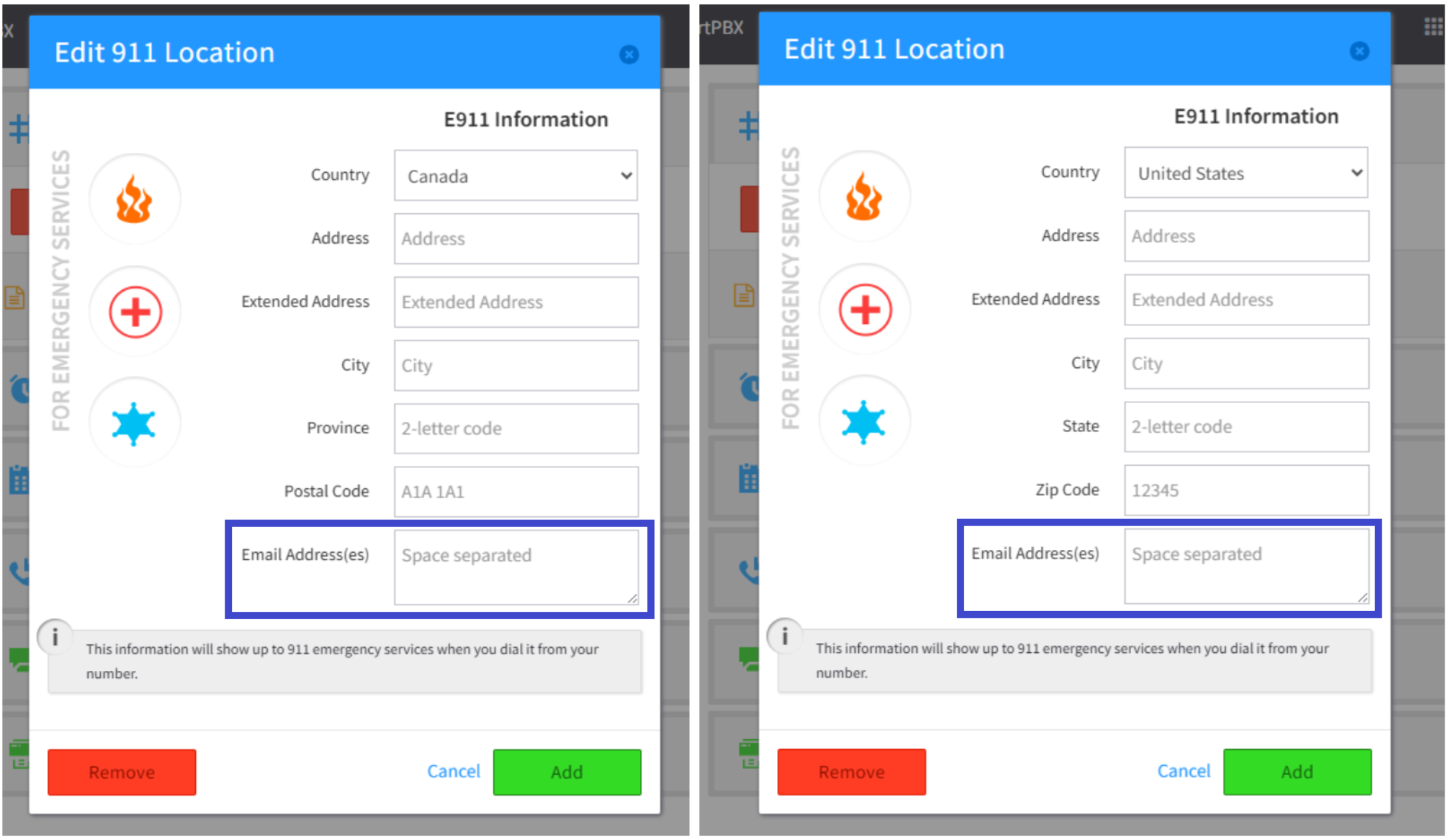
Configuring the Email Address(es) for Emergency Call Notifications
Email address(es) can be configured in the same “Edit E911 Location” form used to set the Emergency Base Address for the Emergency Caller ID in the Numbers app, which should be configured as part of compliance with the RAY BAUM’s Act.
How It Works
The 2600Hz Platform supports Kari’s Law notification requirements:
- 2600Hz does not require a prefix to dial 911, even though the dial plan may require a prefix to dial other phone numbers on PSTN.
- 2600Hz generates email notifications whenever a 911 call is placed.
When an emergency call is initiated, notification emails are sent to all email addresses configured in the Email Address(es) field of the Emergency Caller ID record within the Numbers app. In addition, notification emails are sent to the account administrators associated with the account.
Note: the Ray Baum Act and Kari's Law are applicable only in the US and Canada, as they rely on legal requirements that are unique to these countries and are not established in other jurisdictions
Was this article helpful?
That’s Great!
Thank you for your feedback
Sorry! We couldn't be helpful
Thank you for your feedback
Feedback sent
We appreciate your effort and will try to fix the article